
From Pattern to Playback
A creative exploration by Florida State University, inspired by the Michael Ford Collection
What if a textile could be heard?
For architect and designer Michael Ford, rhythm has always been at the heart of his work. Drawing inspiration from hip hop culture, architecture, movement, and community, his textiles communicate through pattern long before they're ever experienced in a space.
For NeoCon 2026, an intriguing question emerged: What if those patterns could become music?
Florida State University Associate Professors Dr. Karen McLaughlin Large (Associate Professor of Flute) and Dr. Stephanie Sickler (Associate Professor of Interior Architecture and Design) took on the challenge, translating three textiles from Michael Ford's collection into original musical compositions. Rather than simply creating music inspired by the patterns, they developed a system for turning the patterns themselves into music.
The concept intrigued Ford, opening up an entirely new way to experience the collection: visual elements could become musical information, allowing the character of each textile to shape its own sound.
Drawing loosely from musical influences including The Sugarhill Gang, Missy Elliott, and DJ Screw, each composition developed its own distinct voice while remaining rooted in the textile that generated it.
The result is a new way of experiencing design—one that invites us not only to see pattern, but to hear it.
The Translation Process
How Upholstery Becomes Music
Every composition began the same way—not with instruments or sheet music, but with a textile.
Working pattern by pattern, the FSU creators developed a structured method for translating visual elements into musical decisions. Rather than interpreting the designs emotionally, they allowed each pattern’s own visual language—color, shape, geometry, line direction, and repetition—to generate its composition.
While every textile required a different approach, each followed the same creative journey.
Geometry became rhythm.
Color became melody.
Pattern became score.
After the original compositions were complete, Michael Ford and his creative team at BrandNu remixed each piece, adding their own creative interpretation while preserving the musical foundation generated by the textile.

The Patterns at Play
-
Dance Off
-
Cypher
-
Bronx Composition



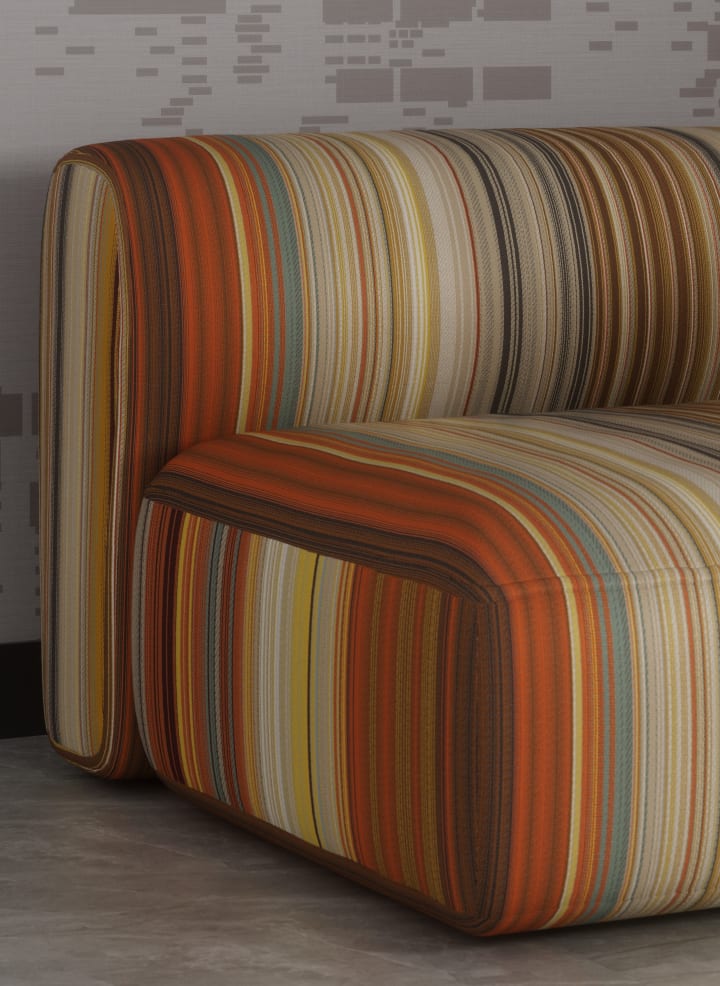
Dance Off
Dance Off
Loosely influenced by The Sugarhill Gang
Every curve found its rhythm.
The ovals at the heart of Dance Off became the foundation for its musical translation, with their forms mapped into chords. From there, the pattern was divided into a grid and the most prominent curved line within each cell became a rhythmic cue.
Depending on the direction each curve faced, it was assigned one of four rhythms heard through the hand drums. Layered together, those chords and rhythms transform the textile’s expressive movement into music—carrying the energy and spontaneity of Dance Off from pattern into sound.
Hear the Pattern
Listen to the FSU creators’ original composition at left, then hear Michael Ford and the BrandNu Design Studio team put their own spin on it in the remix below.
Every curve found its rhythm.
The ovals at the heart of Dance Off became the foundation for its musical translation, with their forms mapped into chords. From there, the pattern was divided into a grid and the most prominent curved line within each cell became a rhythmic cue.
Depending on the direction each curve faced, it was assigned one of four rhythms heard through the hand drums. Layered together, those chords and rhythms transform the textile’s expressive movement into music—carrying the energy and spontaneity of Dance Off from pattern into sound.
Hear the Pattern
Listen to the FSU creators’ original composition at left, then hear Michael Ford and the BrandNu Design Studio team put their own spin on it in the remix below.
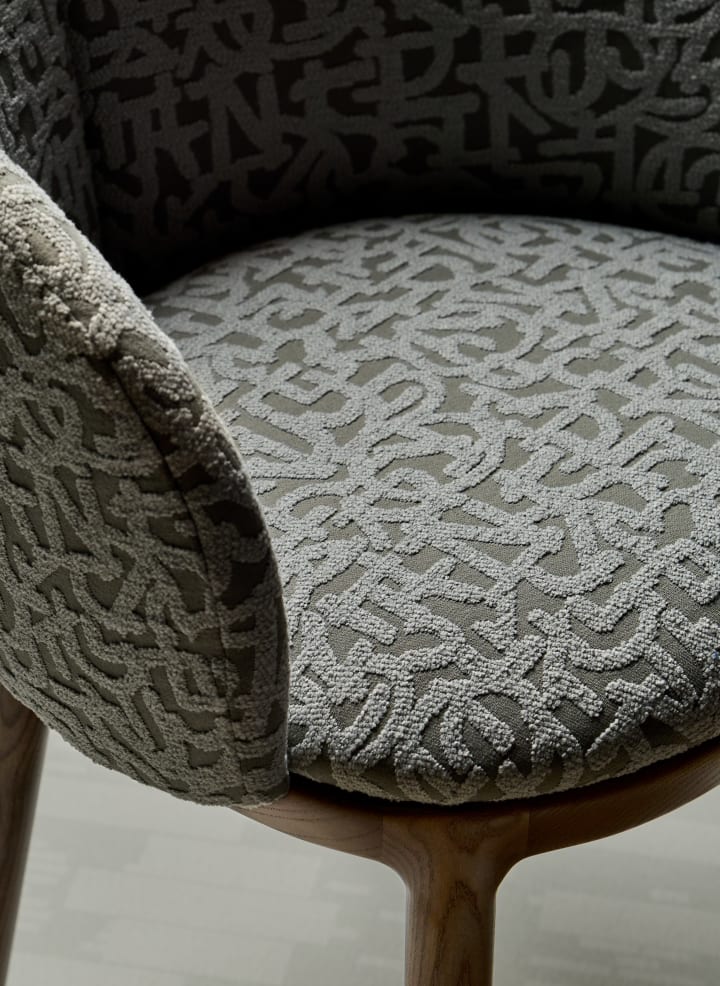
Cypher
Cypher
Loosely influenced by Missy Elliott
The grid became the score.
Built around the repeated phrase “I AM HIP HOP,” Cypher already offered a natural framework for musical translation. Reading horizontally, its grid informed the rhythm; reading vertically, the pattern generated the melody.
The professors took the translation one step further, creating a musical cypher from Missy Elliott’s name to form the bass line. Together, these layers turn the textile’s letters, geometry, and repetition into an evolving composition—one that changes bar by bar while preserving the flow of the original pattern.
Hear the Pattern
Listen to the FSU creators’ original composition at right, then hear Michael Ford and the BrandNu Design Studio team put their own spin on it in the remix below.
The grid became the score.
Built around the repeated phrase “I AM HIP HOP,” Cypher already offered a natural framework for musical translation. Reading horizontally, its grid informed the rhythm; reading vertically, the pattern generated the melody.
The professors took the translation one step further, creating a musical cypher from Missy Elliott’s name to form the bass line. Together, these layers turn the textile’s letters, geometry, and repetition into an evolving composition—one that changes bar by bar while preserving the flow of the original pattern.
Hear the Pattern
Listen to the FSU creators’ original composition at right, then hear Michael Ford and the BrandNu Design Studio team put their own spin on it in the remix below.
Bronx Composition
Bronx Composition
Loosely influenced by DJ Screw
Every color became a note.
To create the piece, Bronx Composition was divided into 128 beats. At each beat, the color of the line determined a musical pitch, creating a sliding melody that became the foundation for the composition.
Every additional musical layer was informed by those original notes, allowing the textile itself to guide how the piece developed. What begins as a sequence of individual colors ultimately becomes a layered musical whole—echoing the pattern’s larger theme of community and collective expression.
Hear the Pattern
Listen to the FSU creators’ original composition at left, then hear Michael Ford and the BrandNu Design Studio team put their own spin on it in the remix below.
Every color became a note.
To create the piece, Bronx Composition was divided into 128 beats. At each beat, the color of the line determined a musical pitch, creating a sliding melody that became the foundation for the composition.
Every additional musical layer was informed by those original notes, allowing the textile itself to guide how the piece developed. What begins as a sequence of individual colors ultimately becomes a layered musical whole—echoing the pattern’s larger theme of community and collective expression.
Hear the Pattern
Listen to the FSU creators’ original composition at left, then hear Michael Ford and the BrandNu Design Studio team put their own spin on it in the remix below.

